Assay Development & Cell Model Selection
- Tumor and primary lines, iPSC and organoids, or we build a custom reporter line expressing your target.
- Built for the FDA push away from animal testing, then qualified for signal window and robustness.
Regulated And Inspected By:




Reporter, proliferation, killing and signaling formats on banked, qualified lines, with variability budgeted in the validation plan rather than discovered in QC.
The tiles show the potency and function questions we answer in cells, with follow-on work linked to the service page that owns it.
ADCC and CDC reporter bioassays
Read moreAntigen positive and negative lines, IC50, co-culture
Read moreTDCC, target lysis, T-cell activation
Read moreCo-culture killing, CD69, spheroid models
Permissive line, transgene expression
Read moreSerum inhibition of pseudovirus entry
Read moreHigh-volume IC50 across compound sets
Whole blood or PBMC stimulation
Read moreCell work fails on variability that begins in the flask. Banking, qualification and mechanism-reflective design are settled ahead of validation.
20+Years Of Cell Culture And Bioassay Work, Since 2003
500+Custom Methods, Including Cell-Based And Plate-Based
Any scope change goes through a pre-approved SOW addendum, so your cost cannot move without an SOW addendum you have already approved. You get a transparent, itemized quote up front, scoped to your cell system, readout and plate count rather than priced off a flat rate. Cell-based assay development typically runs two to four weeks, with validation in four to six, and your audited report with full validation detail follows about two weeks after that. You can opt for rolling data and act on results before the report lands. Cell banks, donor lots and passage numbers are controlled and documented from the first plate, and we work to current FDA and ICH guidance unless your program says otherwise.
Three things get you a quote: your readout and endpoint, proliferation, viability, cytotoxicity, reporter or potency, your cell system, an established line or primary donor cells, and the validation rigor you need, fit-for-purpose or GxP. If you already have a protocol, a cell bank, or prior run data, send what you have and we will scope against it. Just starting out, lean on us, because our assay development experience fills in the blanks. We build and bank custom reporter lines in-house, so a construct you do not have yet is not a reason to wait. You get an itemized quote and a timeline back, scoped against exactly what you sent us.
Quoted with permission, names withheld. Yours would be too.
The ability to work with our timelines to meet deadlines is very much appreciated.
Really appreciate the Co-Presidents’ hands-on approach.
We have worked with NorthEast BioLab for over ten years given their commitment to highest quality bioanalytical data.
This study, same as all other bioanalytical studies, was completed with top quality and reporting standard with incredible responsiveness.
The expertise, competence and responsiveness demonstrated in setting up our clinical trial and preparing and shipping sample kits to the clinical site have been excellent.
There was an issue with half-life extrapolation, and NorthEast BioLab brought in the right experts to find the solution.
We build and bank reporter lines in-house rather than depend on a vendor, and release data in stages to fit your timeline.
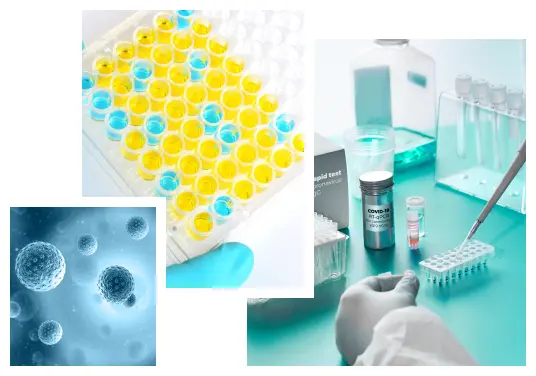
Understand Plate, Cell Based Neutralizing Antibody Assay Development And Validation, NAb Assay Techniques, Cell Based NAb Assays, Neutralizing Antibody Titers …
When no reporter line exists, building and banking one is a step inside the plan, not a detour.
We confirm your readout gives a usable signal window in the cell system your study needs.
Itemized scope, cell system and reagent sourcing settled, timeline agreed before work starts.
Culture conditions, seeding density, incubation and readout optimized, reporter line built if needed.
Two to four weeks to develop, four to six to validate, fit-for-purpose or full GxP.
Treated and control arms plated together, with replicates and plate controls per run.
Curves, potency values and the plate-level raw data, about two weeks after the last run.
Because assay stability is engineered in at the cell bank, and the validated method transfers into GxP release and CLIA testing without a rebuild.
Regulated And Inspected By:






A potency assay is finished when someone outside your company accepts the number. The services that number supports are linked below.
What potency owners ask when a lot is waiting, answered.
A potency assay anchors related readouts in cytotoxicity, MOA and flow, each run by the scientists who built your method.