Dose Response, IC50 And GI50 In Cancer Lines
- Full curves across your panel, drawn from 200+ cancer cell lines we hold in house or source.
- Replicates and plate layout designed so that edge effects do not get read as biology instead.
Regulated And Inspected By:




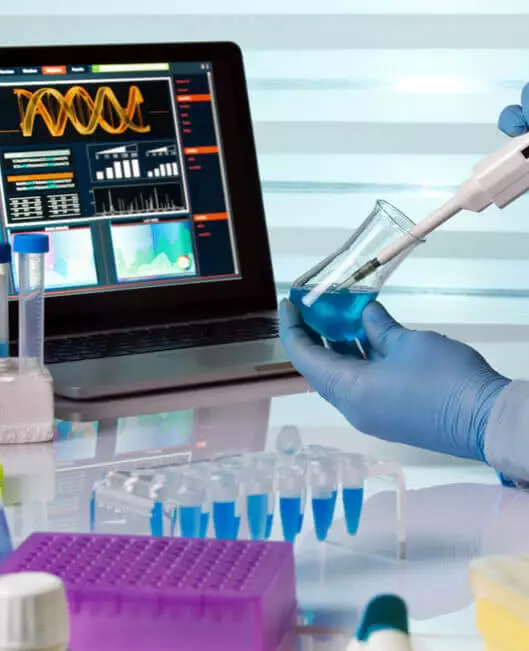
Luminescence, imaging and flow endpoints across tumor and primary lines, with effector-to-target work for biologics and co-culture where the mechanism demands it.
Every tile pairs a molecule class with the endpoint that fits its mechanism, and related work is linked wherever the thread continues.
Dose response and selectivity index across tumor panels and matched normal lines
Payload driven killing with the free payload run alongside the conjugate
Read moreEffector to target co-culture killing, with cytokine and granzyme readouts alongside
Read moreKilling potency for natural killer and engineered cell products in characterization
Redirected killing where the molecule brings effector and target cell together
Cell killing and viability for oncolytic and vector based therapeutic candidates
Cytotoxicity screening for peptide therapeutics and natural product derived leads
Growth inhibition and antibody-driven killing, with effector co-culture where needed
Readout choice, timing and edge effects are where curves go wrong. We run orthogonal endpoints where the decision is close, so the ranking is real.
20+Years Of Cell-Based Assay Work For Biotech, Since 2003
500+Custom Methods, Including Cell-Based Potency Assays
Any scope change goes through a pre-approved SOW addendum, so your cost cannot move without an SOW addendum you have already approved. You get a transparent, itemized quote up front, scoped to your compound count, cell lines and replicate design rather than priced off a flat rate. A screening cassette against an agreed panel typically turns around in one to two weeks, and sometimes faster than that. Assay development for a new line or a new readout runs three to four weeks, and a qualified method takes longer than that. You can opt for rolling data and act on a clear result before the report ever lands. Cells and compounds stay under documented chain of custody from the day they arrive.
Four things get you a quote: your compounds and how many, the cell lines you want, the readout if you already know it, and whether you need a matched normal arm for selectivity. We hold over 200 cancer lines in house and source anything else per project, so the panel is rarely the constraint. Tell us the mechanism too, because that is what decides the readout and the incubation window. If a biochemical assay against the purified target would answer your question more cheaply first, we will tell you so rather than sell you a cell panel. Send the compound list and the panel you have in mind and you get an itemized quote and a timeline back.
Quoted with permission, names withheld. Yours would be too.
We trust NorthEast BioLab to design and execute streamlined, impactful bioanalytical projects
NorthEast BioLab offers a science-based, hands-on approach to the latest bioanalytical platforms
We worked closely to implement the most efficient and cost-effective bioanalytical assay for our PK Studies.
NorthEast BioLab always exceeds expectations on bioanalytical assay development, validation, and sample analysis.
We have worked with NorthEast BioLab for over ten years given their commitment to highest quality bioanalytical data.
This study, same as all other bioanalytical studies, was completed with top quality and reporting standard with incredible responsiveness.
We check for compound interference with the detection chemistry before choosing a readout, across 200-plus cancer lines held in-house or sourced.

A guide to the main assay types, how an assay is developed and validated, and where each one fits in drug discovery…
The assay window is proven on your controls before the panel runs, so a flat result points to the molecule rather than the setup.
Lines picked from our bank or sourced, readout and window set to your mechanism.
Itemized scope, cell line sourcing and timeline agreed before any work starts.
Your compound is tested against the detection chemistry before the panel runs.
A pilot curve sets the concentration range so the full panel is not wasted.
Tumor and matched normal arms run together, with replicates and plate controls.
Curves, IC50 or GI50 values and the selectivity index, with the raw plate data.
Because a close call gets a second, independent readout before it is reported.
Regulated And Inspected By:






One curve on its own settles very little; the why and the how-much complete the story. The services that tell it together are linked below.
What pharmacologists ask before trusting a kill curve, answered.
A kill curve usually leads to MOA, potency or flow questions, which our cell biology team answers next.