Services
Platforms
Solutions
About Us
 About Us
 Overview
 Leadership
 Facility & Equipment
 Quality & Compliance
 Therapeutic Areas
 Why Us?
 Values
 Process
 Partners
 Careers
Sr. Scientist – Cell Based Assay
Associate Scientist, Central Laboratory Services
Business Development Associate
Sr. Scientist, LC-MS/MS Bioanalysis – Hamden, CT, USA
Sr. Scientist, ELISA Immunoassay Bioanalysis – Hamden, CT, USA
GLP Quality Assurance Manager
Sr. Scientist - Pharmacokinetics (PK)
Content Manager, Scientific and Regulatory Writing
Resources
Integrated Proviral DNA, Absolute Answers: TaqMan Absolute Q dPCR for Lentiviral VCN Determination

Challenge
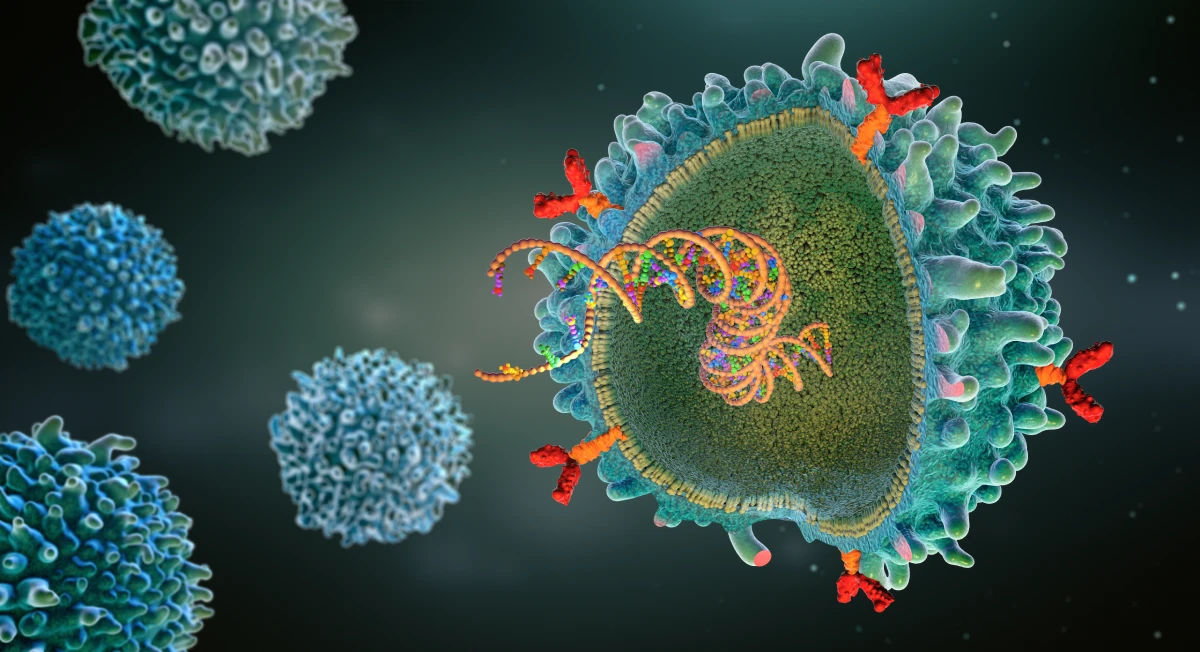
Lentiviral vectors are widely used for stable gene delivery because they can transduce both dividing and non-dividing cells, enabling long-term transgene expression. But whether you’re running basic research or advancing a cell and gene therapy program, you need a titration method that is precise, reproducible, and transferable—especially when decisions like multiplicity of infection (MOI), dose selection, and product release depend on it.
Traditional qPCR-based lentiviral titration can be slow and calibration-heavy. Accurate quantification typically requires a standard curve built from a control template with a known copy number, and results can be sensitive to amplification efficiency, inhibitors, and operator-to-operator variability. These challenges become more pronounced when sample input is limited or DNA quality is suboptimal.
Solution
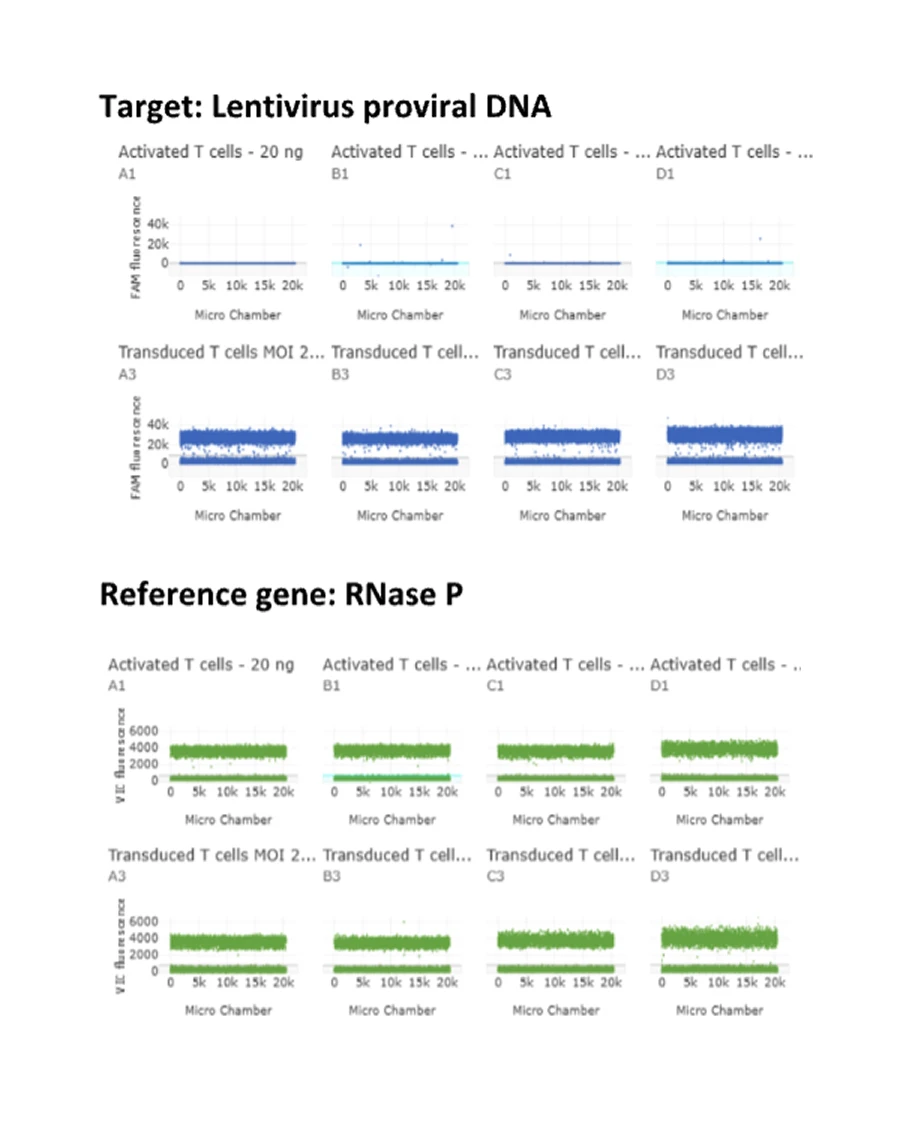
To solve this, we implemented a TaqMan-based QuantStudio Absolute Q digital PCR (dPCR) workflow that quantifies integrated proviral DNA in transduced cells, delivering a precise, standard-curve-free measure of vector copy number (VCN) to support lentiviral titration and MOI decisions. The workflow partitions each sample into thousands of individual PCR microreactions, some containing the target (positive) and others not (negative), then uses the fraction of negative partitions to calculate absolute copy number via Poisson statistics. To solve this, we implemented a TaqMan-based QuantStudio Absolute Q digital PCR (dPCR) workflow for functional lentiviral titration by measuring integrated proviral DNA in transduced cells. dPCR works by partitioning a sample into thousands of individual PCR microreactions: some contain the target (positive) and others do not (negative). After endpoint amplification, the fraction of negative partitions is used to calculate absolute copy number using Poisson statistics—delivering direct quantification without a standard curve.
The more biologically meaningful readout of lentiviral transduction is not “how much viral genome is present,” but how many proviral DNA copies are integrated per cell commonly reported as vector copy number (VCN). Measuring VCN provides a direct view of transduction performance and supports rational selection of MOI without relying solely on proxy readouts such as fluorescence.
Our approach combined the strengths of both platforms:
- qPCR for assay setup and primer/probe optimization We used serial dilutions of known viral DNA to verify TaqMan primer/probe specificity, establish amplification efficiency, and define limit of detection (LOD) and expected Ct values across dilutions. This step builds confidence that the assay chemistry is robust before moving to absolute quantification.
- Absolute Q dPCR for final copy-number quantification (vector copy number, VCN) We then transferred the optimized assay to the QuantStudio Absolute Q Digital PCR System for absolute quantitation of lentiviral integration. A multiplex TaqMan design was used:
- Target: Lentivirus proviral DNA (integration marker)
- Reference gene: RNase P (cellular control for genome equivalents / normalization)
This target + reference strategy supports accurate copies-per-cell calculations and reduces sample-to-sample variability caused by differences in input DNA. A one-step dPCR workflow (e.g., ViralSEQ dPCR Lentivirus Physical Titer Kit, Thermo Fisher Scientific) streamlines determination of copy number across serial dilutions and confirm the quantitative range.
Why dPCR improves lentiviral titration:
- Absolute quantification (no standard curve required)
- Strong performance at low copy number (less variability than qPCR near the lower range)
- High precision, sensitivity, and reproducibility across runs
- Better tolerance of challenging sample inputs (low DNA quantity, lower-quality material)

Outcome
We developed a reliable, transferable multiplex TaqMan Absolute Q dPCR assay for lentiviral titration using proviral DNA + RNase P. This workflow delivers endpoint absolute quantification of integrated lentiviral genomes, reducing calibration burden and minimizing susceptibility to run-to-run variation.
By enabling accurate determination of infectious titer, MOI optimization, and vector copy number (VCN), the assay provides critical process and product insights for lentiviral vector manufacturing and gene-modified cell therapy development. These metrics support:
- Improved control of gene transfer efficiency
- Better-informed dose selection and MOI setting during transduction
- Stronger characterization for quality attributes linked to safety and performance
Overall, this case study supports digital PCR (dPCR) as a powerful tool for lentiviral infectious titer and VCN determination, helping advance cell and gene therapy programs targeting diseases such as cancer, HIV, cardiovascular disorders, neurodegenerative diseases, and asthma through more onsistent, data-driven development decisions.
Registered And Inspected By Various Regulatory Agencies






Speak To Our Scientist About Your Multiplex Cytokine Assay, Cytokine Quantification On Meso Scale Discovery
Similar Case Study Articles
-
Humanized Monoclonal Antibody (MAb) PK ELISA Development, GLP Validation, And MAb Bioanalysis
-
Oligonucleotide Hybridization ELISA PK Assay, GLP Validation, Sample Analysis
-

TaqMan Gene Expression Assay, Copy Number Variation
-

Genomic Variation Analysis – TaqMan Single Nucleotide Polymorphism (SNP) Analysis
-

LC MS Bioanalysis Of Oligos Using Mass Spec And Ion Pair Chromatography
-
Dosing THC Lab, Cannabis Testing Lab, CBD Melatonin Testing
-
HPLC-UV Method Development: Testing 9 Articles in Formulation
-
Payload Plus Peptide LC MS Analysis, GLP Validation In Rat, NHP, Human Plasma
-

Epigallocatechin gallate (EGCG) LC MS Analysis In VcEDTA Human Serum
-
LC MS Method For Proline Amino Acid, Hydroxyproline In Mouse Tissues
-
LC MS Method For DNA Adducts Analysis In Cell-Based In-Vitro Samples
-
LC MS Method for Everolimus Eluting Coronary Stent Drug Delivery Systems
-

Mass Spectrometry Amino Acids, Quantitative LC MS Amino Acid Analysis
-

LC MS Method Development And GLP Validation For PK Plasma Sample Analysis
-
Incurred Sample Reanalysis (ISR) Test, FDA Requirements, And Study Evaluation
-
Dried Blood Spot (DBS) Sampling, DBS Collection, And DBS Analysis